Specular Differentiation






The Python package specular implements specular differentiation, which generalizes classical differentiation.
See References for more details.
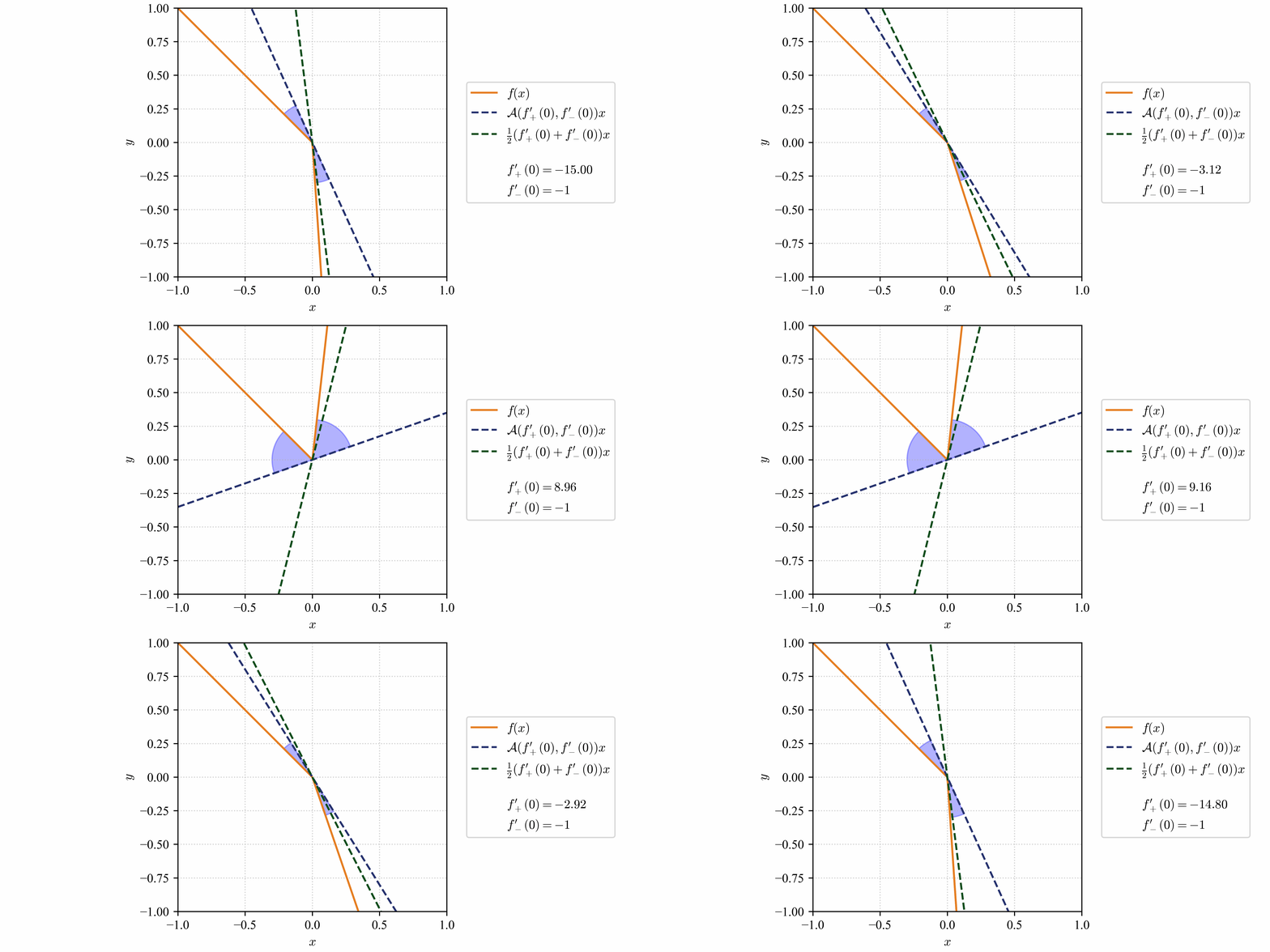
The specular derivative is defined by averaging the angles associated with the forward and backward difference quotients:

where \(f_{+}'(x)\) and \(f_{-}'(x)\) are the right and left derivatives of \(f\) at \(x\), respectively. In contrast, the symmetric derivative takes the arithmetic mean of these derivatives. The animation below compares the two: the dashed blue and green lines have slopes equal to the specular and symmetric derivatives, respectively.
Installation
Requirements
specular-differentiation requires:
- Python >= 3.14
numpy>= 2.4
Additional backends are available through optional dependencies:
numba:numbajax:jax,jaxlib
Standard Installation
pip install specular-differentiation
The package is distributed as specular-differentiation and imported in
Python as specular.
This installs scaled_mean, derivative, gradient, and jacobian, using
NumPy by default, as well as the scalar ODE methods and the SPEG optimizer.
Backend selection is
available through set_backend, get_backend, use_backend, and
available_backends.
Optional features
pip install "specular-differentiation[numba]"           # Numba backend
pip install "specular-differentiation[jax]"             # JAX backend
Developer installation
pip install -e ".[dev]"
Backend support
| Backend | Availability | Minimum version |
|---|---|---|
| NumPy | Default | numpy >= 2.4 |
| Numba | Optional | numba >= 0.65 |
| JAX | Optional | jax >= 0.10, jaxlib >= 0.10 |
Quick start
The following simple example calculates the specular derivative of the ReLU function \(f(x) = max(0, x)\) at the origin.
import specular

ReLU = lambda x: max(x, 0)
print(specular.derivative(ReLU, x=0))
0.41421356237309503
Documentation
LaTeX Macro
To use the specular differentiation symbol in your LaTeX document, add the following code to your preamble (before \begin{document}):
% Required packages
\usepackage[T1]{fontenc}
\usepackage{amsmath}
\usepackage{graphicx}
\usepackage{amssymb}

% specular derivative symbol
\newcommand{\sd}{\mathord{\prime\mkern-2.5mu\reflectbox{$\scriptstyle\prime$}}}

% specular Gateaux derivative symbol
\newcommand{\sGd}{%
    \mathord{\text{\normalfont\UseTextSymbol{T1}{\dj}}}%
}

% specular Frechet derivative symbol
\newcommand{\sFd}{%
    \mathord{\text{\normalfont\UseTextSymbol{T1}{\DJ}}}%
}

% specular gradient symbol
\newcommand{\sg}{%
  \mathchoice
    {\mathord{\raisebox{-0.05ex}{\rule{0pt}{1.3ex}\smash{\scalebox{1.37}[1.22]{\ensuremath{\displaystyle\blacktriangledown}}}}\mkern-1.2mu}}
    {\mathord{\raisebox{-0.05ex}{\rule{0pt}{1.3ex}\smash{\scalebox{1.37}[1.22]{\ensuremath{\textstyle\blacktriangledown}}}}\mkern-1.2mu}}
    {\mathord{\raisebox{-0.03ex}{\rule{0pt}{1.0ex}\smash{\scalebox{1.29}[1.15]{\ensuremath{\scriptstyle\blacktriangledown}}}}\mkern-0.8mu}}
    {\mathord{\raisebox{-0.02ex}{\rule{0pt}{0.8ex}\smash{\scalebox{1.18}[1.05]{\ensuremath{\scriptscriptstyle\blacktriangledown}}}}\mkern-0.5mu}}
}
For usage examples and Markdown notation, see LaTeX Macro in the User Guide.
Citing specular-differentiation
To cite this repository:
@software{specular_diff,
  author = {Jung, Kiyuob},
  title = {{specular-differentiation}},
  doi = {10.5281/zenodo.18246734},
  url = {https://github.com/kyjung2357/specular-differentiation},
  version = {1.3.3},
  year = {2026},
}
References
One dimension
[1] K. Jung. Specular differentiation in one dimension: a quasi-mean value theorem, regularity, and discontinuities. arXiv preprint arXiv:2601.09900v5, 2026.
[2] K. Jung and J. Oh. Regular specular differentiation in Euclidean spaces. arXiv preprint arXiv:2210.06062v3, 2022.
Higher dimensions
[3] K. Jung. Specular differentiation in normed vector spaces: Quasi-Mean Value and Quasi-Fermat Theorems. arXiv preprint arXiv:2601.10950v4, 2026.
Applications
[4] K. Jung. The specular ellipse method for scalar ordinary differential equations: exactness and accuracy up to fourth order. arXiv preprint arXiv:2608.30280, 2026.
[5] K. Jung and J. Oh. Nonsmooth convex optimization using the specular gradient method with root-linear convergence. arXiv preprint arXiv:2412.20747v3, 2024.
[6] K. Jung. Specular gradient methods for nonsmooth convex optimization in Euclidean spaces: a subgradient selection strategy. arXiv preprint arXiv:2605.25490, 2026.